Billy Evans is the real subject of You Can See Everything
A beautiful film about people I found pretty repulsive, and why Billy Evans’s attempts at control left me less certain about who was influencing whom.
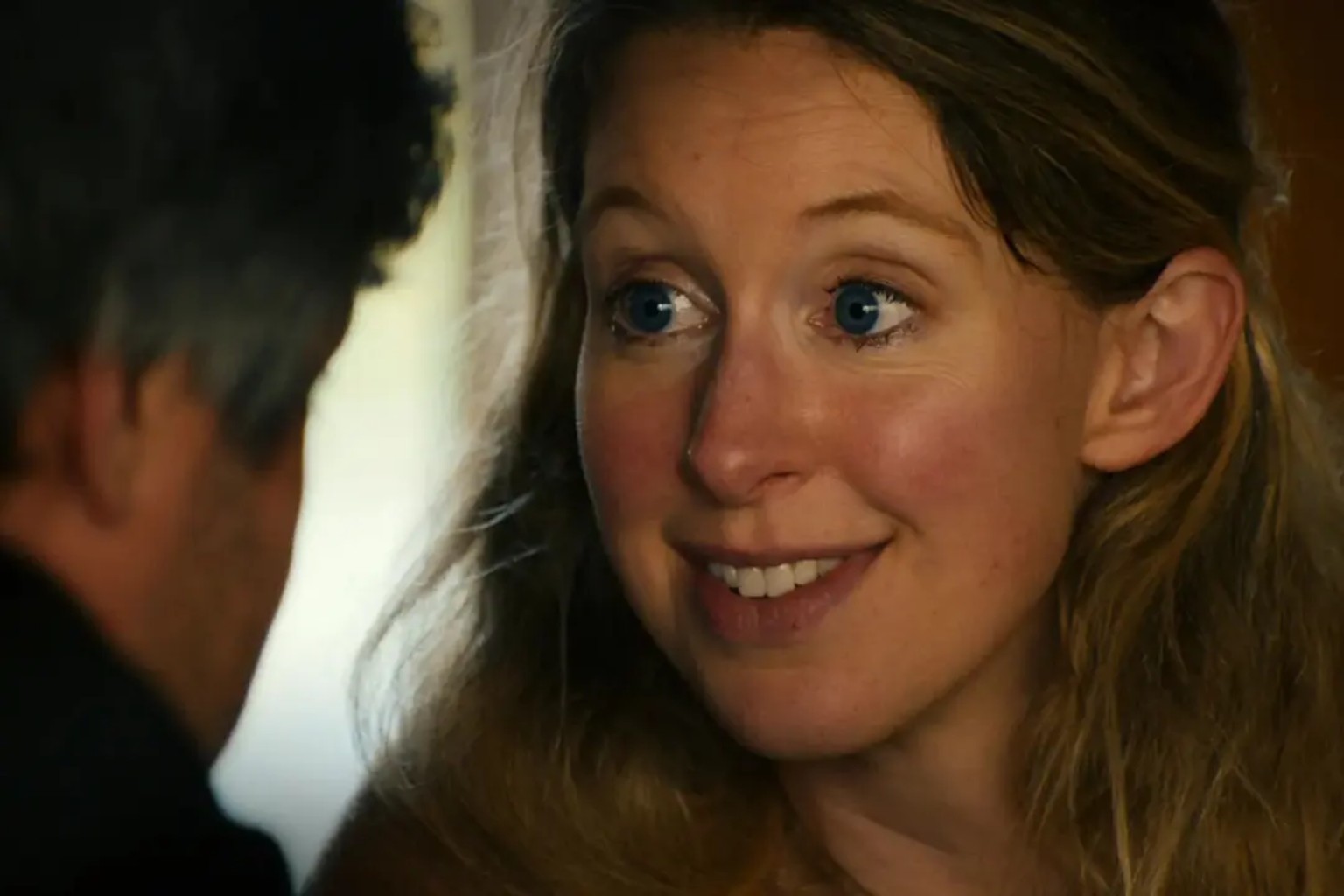
You Can See Everything is a beautiful film about people I found pretty repulsive, and I still don’t entirely know what to make of it. I went in expecting to spend most of my time trying to understand Elizabeth Holmes, but Billy Evans ended up being the person I was watching most closely.
Holmes is the reason we are there, but Evans keeps changing what the film is about. His interruptions, his reactions, and his attempts to manage how everyone sees them make it difficult to treat him as a supporting character in her story. For much of the film, he also makes it very easy to see her as someone who needs protecting, which becomes more complicated the longer you sit with it.
Holmes is difficult to read
There were a few moments where I felt like I caught her performing, or briefly coming out of a performance before returning to it. The scene involving Abbott and Costello’s Who’s on First? was where I felt this most clearly. She seemed to understand why it was funny, and then suddenly seemed unable to remember a key part of what made it funny in the first place. The prolonged close-ups of their faces make those shifts easier to notice, and the decision to hold them for so long felt very deliberate.
I couldn’t reconcile those reactions, and the shift made me suspicious of the confusion she was presenting. It felt like I had briefly seen something that didn’t quite fit the person she was otherwise showing us.
That doesn’t establish that she was pretending, but it affected how I watched her afterwards. Holmes has a history of making people feel protective of her, and I found myself wondering how much of that apparent vulnerability was sincere, how much was useful, and whether she experiences those as separate things.
Billy, meanwhile, has almost no poker face. His irritation and self-satisfaction are much easier to read, but that openness initially made me give him more credit than I think he deserved. Being able to see what someone is feeling doesn’t mean they understand what they are doing.
Billy seems remarkably unaware of how he comes across
His regular interference with Nathan’s questions made him look so bad that I started questioning his awareness of his own image. He repeatedly steps into conversations in ways that make him seem controlling, and he often appears to believe he is helping.
This became particularly uncomfortable during the evening with Amanda Seyfried, when he dismissed her as an actress and presented himself as much more well read. The implication seemed to be that her opinions were inherently worth less because of what she did for a living, but the conversation made his own judgement look much worse.
She was engaging with what was in front of her, and he seemed more interested in establishing that he was the kind of person whose opinion should count.
There are so many moments like this. He talks about how good he is at sex, how intelligent he is compared with other people, and the dangerous people he knows. The arrogance is so excessive that he often looks honestly stupid, and I don’t mean that as a substitute for explaining what bothered me. He seems unable to recognise how little these claims establish, or how much making them damages the impression he wants to create.
In retrospect, this made me question whether I had been too quick to cast him as the mastermind. His behaviour certainly looks controlling, but his ability to interrupt people or make decisions for Holmes doesn’t necessarily mean he understands her better than anyone else does. He may be very confident about a relationship he doesn’t fully understand either.
Holmes can be a villain and a victim
There is no contradiction in someone having caused enormous harm and also being treated badly. Holmes’s responsibility for Theranos doesn’t make everything that happens to her deserved, and Billy’s behaviour is disturbing regardless of what I think of her.
His power of attorney and the control he exercises over her public image make the relationship feel especially unequal while she is in prison. The AI versions of her are unsettling because her likeness becomes something he can make available for other people to use, and the fact that he has legal authority doesn’t answer the question of how much say she meaningfully has.
At the same time, I don’t entirely believe the version of vulnerability we are offered. Holmes is difficult to read in a way Billy isn’t, and his obvious unpleasantness makes it easier to stop scrutinising her.
I kept moving between suspicion of her and discomfort at how he treated her. Neither reaction cancelled the other out, but the film made it surprisingly tempting to let one explain everything.
Fielder becomes part of what we are watching
My suspicion is that Holmes and Evans thought they would be able to manage Nathan Fielder. His reputation for comedy and his awkward manner may have made him seem easier to steer than he actually is, although his earlier work should probably have discouraged that assumption.
He is very good at letting people continue explaining themselves until the explanation becomes revealing. Billy, in particular, seems willing to keep talking long after it has stopped helping him.
Fielder’s involvement also means his own reactions become part of the subject. He develops feelings about these people, intervenes in what is happening, and makes decisions about how to represent encounters we cannot independently see. I found his concern for Holmes understandable, but I also wanted to know how much that concern was shaping the version of her reaching us.
Some of the film’s dimly lit, intimate conversations looked almost baroque to me, with the lighting and the way people were positioned in the frame making the scenes feel carefully composed. I noticed it in Fielder’s conversations with Holmes and Evans, and sometimes even with Seyfried. I found it beautiful, but the more deliberately composed these intimate moments looked, the more I questioned how curated the documentary might be and how much its visual style was shaping my interpretation of the people in it.
Amanda Seyfried seems to occupy the audience’s position for much of this. She watches, questions, and challenges interpretations that have started to feel comfortable. There is an obvious irony in her doing that after playing Holmes in The Dropout, because she helped create one of the performances through which people already understood this story.
Her role becomes particularly interesting when she questions Fielder himself. By then, he has spent so much time trying to understand Holmes that his confidence in his own reading of her starts to deserve the same scrutiny he has given everyone else.
The new company makes this feel less like a story about the past
Billy’s diagnostics venture is called Haemanthus, and WIRED’s reporting on the company describes a business that has yet to release a product and whose incorporation documents do not include Holmes’s name. That doesn’t establish that the company is fraudulent, or that no meaningful work is happening.
It does make the film harder to keep at a comfortable distance. There is another company, another set of promises, and another opportunity for people to decide whom they trust. Watching Billy explain himself made me wonder what an investor would find persuasive about him, and whether the qualities that looked so unconvincing to me would register differently in a room where people already wanted to believe.
The moment I keep coming back to
At one point, Billy tells Nathan what Elizabeth would say if she were there with them, describing their actions in terms of building monuments of love. In the moment, it felt like an extraordinarily self-centred thing to put in her mouth. He seemed to be explaining her inner life for her, and the explanation happened to place him at its centre.
Later, we see the reenactment of Fielder’s prison visit with Holmes, reconstructed from his recollection, and she expresses almost the same idea.
I had initially heard Billy’s version as evidence of how much he wanted to control her, but hearing it attributed to her made me reconsider where it had come from. Had she absorbed his way of describing their relationship, or had he been repeating hers? By that point, I wasn’t sure who had influenced whom.